The Swastika and the Laundry: or…what on earth were they thinking of? April 22, 2007
Posted by WorldbyStorm in Culture, Ireland.trackback
For some reason the thought of the Swastika Laundry came into my mind the other day.
For those unaware of this particular slice of Irish material culture the Swastika Laundry was a venerable institution in Dublin, founded in 1912. It operated from Shelbourne Road in Dublin 4 and remained in business until the late 1960s. I remember vividly the cream and brown coloured labels they used to tag their deliveries and the electric vans that they were delivered in. Now, seeing as this would have been 1967 or 8 it must have been just prior to their eventual demise.
And quite a sight the labels and vans were too, emblazoned with that most remarkable of symbols, the…er…swastika. The photograph below is available on the Dublin City Council website, and depicts the livery of the company on a van used in the series “Caught in a Free State”. I certainly don’t remember the vans as being red, so perhaps this was a previous livery that the company used (or perhaps they overdid the look to make it more Nazi-like – but even so the Swastika remained the symbol of the company).
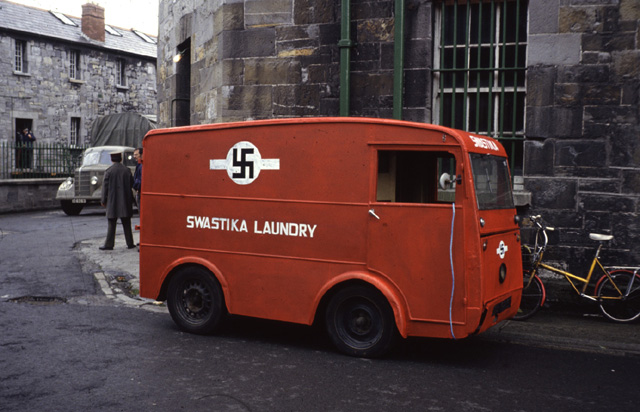
According to an Irish Times report from some years ago the Laundry changed it’s name in 1939 to Swastika Laundry (1912), perhaps in an effort to preempt a successful German invasion of launderers fired up on National Socialism, and ready to orient the Swastika in the opposite direction.
Because it is strange, but true, to consider that the Swastika laundry used the Swastika in it’s original configuration.
Even more strange is the thought that the brick chimney at Shelbourne Road was also decorated with a Swastika and the name of the company up until the late 1960s. Irish Eagle has a photograph which I hope I can get a scan of of just that location.
So what was it about? The logo was introduced at a time well before it’s association with National Socialism. It was a symbol of good luck, originating in India. It was configured facing left to right which is the correct Indian orientation.
Yet it’s hard not to believe, if only judging from the way in which the van above, which would date from the post-War period, is decorated with the Swastika set within a white roundel with two horizontal bars on either side and set against a red field in an almost exact emulation of the Nazi symbol, that the most unpleasant connotations of the symbolism were being – at best – parodied.
So here we have it. Ireland’s capital city, graced with laundry vans plying their trade hither and yon decorated in arguably the most reviled political symbol of human history.
In some respects it speaks of an innocence regarding the power of visual symbolism. But it is difficult to judge at this remove the true motivation behind it’s use. Was it a sense that the Swastika Laundry had it first and therefore it had some ‘ownership’ of the image? It certainly tends to indicate an insularity as to the significations of the Swastika, and perhaps within a culture that reified the written and spoken word over the visual this isn’t quite so surprising.
And it raises interesting and troubling questions regarding the nature of other imagery that has political connotations.


 The Cedar Lounge Revolution
Good grief. I’d never heard of the Swastika Laundry. Comes from having a culchie background perhaps. It’s actually astonishing that they kept going after WW2 and the full detail of the Holocaust became widely known.
Two slightly connected points, while not denying the suggestion that the Swastika is arguably one of the most reviled political symbols in human history, I’ve occasionally wondered what our growing Chinese community thinks of Mao’s restaurant. Or some of our Russian friends think of a pub called after the Soviet newspaper, Pravda.
Finally, in a shamefully blatant attempt to link back to my own story, would the Swastika Laundry be a target for hate crime legislation these days?
LikeLike
Anti-semites. Never sure what balance to strike – eh? Pathological hatred of Jews or mad scrambling to downplay the reality of what was done to them.
LikeLike
WBS, I think you should take down Karl Gray’s comment. Please. There should no place for racist holocaust denial on this site.
LikeLike
+1.
LikeLike
Surely. I’ve already blocked the IP.
LikeLike
There was a large issue made out of Mao’s restaraunt (which is damn good, by the by). The logo used to be Mao’s smiling face, with the colours messed around. Now it’s a cute Asian kid eating a chicken skewer. The only reference to Mao himself now is the name.
LikeLike
I wouldn’t imagine most Russians would be too bothered about Pravda. The impression I’ve got from most of them I’ve met is that they don’t look back on the Soviet era in nearly as much anger as we sometimes think they do.
An establishment named after Boris Yeltsin, on the other hand, would probably get its windows kicked in regularly.
LikeLike
BTW Frank, Joe Tiernan references the Swastika Laundry in his book about the Dublin and Monaghan bombings. That’s the first (and surprisingly, until now, last) place I ever heard of it.
LikeLike
Hate crime legislation? Possibly!
Mao? Never ate there, although had a few pints in Pravda. Still the Mao identity did strike me as a little bizarre.
Windows being kicked in would never happen to the Putin.
What was the reference Joe Tiernan made?
LikeLike
What was the reference Joe Tiernan made?
Can’t remember, but it was made only in passing.
LikeLike
Excellent piece. I can remember, as a very young man, spending a lot of time in the Hitler Bosco until they renamed it after some saint or other.
LikeLike
Cheers!
LikeLike
The Swastika Laundry was established in 1912 and continued to trade sucessfully until it was sold to Initial Services in 1987 now part of Rentokil. It had nothing whatsoever to do with Hitler or anything Nazi but was named when the founder’s wife bought a ornamental black cat with a Swastika symbol around it’s neck which is a symbol for good luck. When the war broke out Swastika Laundry was delivering and collecting domestic laundry to a large proportion of the houses in Dublin. The original company is still in existence but has been renamed and supplies sterile workwear to hospitals etc. The van shown above is not an actual Swastika Laundry van but one prepared especially for a TV film.
LikeLike
That’s why the colour in the picture is wrong. The red was brighter. The Swastika van called once a fortnight to our house – and many others – in Churchtown in the 1950s. I don’t think the logo is quite the same either.
LikeLike
i worked in The Court Laundry Harcourt St, in the early 60s, and you are spot on, it is the wrong colour , and if im not mistaken the wrong van!!, it looks like a Bolands Bread Van,, as almost all the Laundrys, had a box body behind the drivers cab.
LikeLike
P.S. The colour was Red, but a bright Red, what we used to call, Fire Brigade Red,!!
LikeLike
Mark, that is of course true, although all these points were made more generally in the piece above. WRT the van, you’ll note that I have referred to how I do not remember that livery myself and suggested that it was produced for the program.
Having said that, I don’t think that detracts from the central point that symbols have a certain power and resonance and that the swastika perhaps has more than most which is why there is a certain dislocation that the symbol was retained in the post-war period.
Whether this was a function of political or geographic isolation is the key question.
LikeLike
“Whether this was a function of political or geographic isolation is the key question.”
Partly political isolation, partly geographic isolation. Obviously it couldn’t have happened in the UK, but the Republic of Ireland was a very different place post-war.
Most Dublin people were aware that the Swastika Laundry had been in operation long before WW2, and wouldn’t have expected The Emergency to make much difference.
I can’t remember what colour the vans were, some low-key colour, quite different from the red in the picture.
LikeLike
I thought they were a pale cream or a brown, soubresauts, that at least is what my addled 3 year old memory in 1968 registered.
The version in the picture looks a bit – over the top, particular the wings on the swastika roundel…
LikeLike
I remember seeing the Swastika symbol until perhaps the 70s when I was a kid. I am pretty sure it was there all through the 70s. I might have been less than 10 but even I knew it was a wierd symbol to use as I associated it with Nazism and the 2nd world war. So, if I noticed all of those connotations, why didn´t the owners?
LikeLike
Hi , I worked in dublin as a shopfitter in the 60s. I remember the swastika laundry vans going about the city and i am sure they were in colour red.There was a shop beside mcberney on the quays that took in laundry for swastika company. I got my FCA uniform cleaned there every week. Just inside front door was was a information notice on the history of swastika laundry ,founded in 1912.
LikeLike
Thanks Tony for that. Do you or anyone else actually have a photo of them?
LikeLike
hi. no but try THE IRISH FILM BOARD temple bar.
LikeLike
That’s an interesting idea, cheers.
LikeLike
It began life in Dartry in 1888 as the Dublin Laundry Company beside the famous viaduct, “The 9 arches”. See link for more.
The laundry chimney was restored when the Dartry site was redeveloped for flats 9obscuring a nice view of the Dublin mountains).
LikeLike
thanks for that MarkW
LikeLike
I remember seeing the chimney with the swastika symbol and the words “Swastika Laundry” – this was as late as 1988 or 1989 as I was attending a conference in the RDS and had never been beyond the part of Dublin between Heuston Station and O’Connell Street/ Henry Street before the late 1980s.
LikeLike
Brilliant. Still, we haven’t had a photo yet.
LikeLike
I remember the vans around Kilbarrack in the late sixties. I also remember seeing the chimney in the 80s coming out of Lansdowne Road. I once went to Copenhagen to see the Boys in Green get whipped 3-0 by the Great Danes. We took in a tour of the Carlsberg brewery. Two pillars on the way in are adorned with carved swastikas. First thing the guide did was explain to everyone that the swastika is an ancient symbol, that these were on the pillars since the early 1900s, nothing to do with Nazism. I’m pretty sure they are still there today.
Yep, WBS, still no photo.
LikeLike
I was in Pravda years ago and asked some Russian girls next to my party what they thought of it all. They were pretty positive, actually.
(afterwards, the mate I was with said ‘Idris, those girls were 16’).
In St. Petersburg, not only do you see lots of teenagers wearing hammer and sickle t-shirts, but you can also buy primary school copybooks with soviet insignia on them . . .
LikeLike
Well, it’s better than swastika’s on copybooks.
LikeLike
The business was set up in the in 1912 and the owners named it the swastika because back then it was never associated with the nazi’s or genocide it was actually considered good luck. When the war broke out and of course the swastika was used by hitler the owners didn’t now what to do. Instead of changing the name they put “estabished 1912” on it so people would know it wasnt associated with the german’s. Of course remembering that a lot of irish men were fighting the germans at the time.
after the war an old RAF pilot bought the laundry who of course got rid of the name but noticed after a few years that the name was so reconised that he had to name it the swastika once again.
LikeLike
I grew up in Dun Laoghaire born in 1948, left Ireland in March 1967. The Swastika Laundry vans were INDEED bright red and electrically operated, no petrol or diesel here. Well before their time. The Brittain family founded the company in about 1912.
Thes samrt vans were to be seen in Dun Laoghaire, Blackrock etc. The drivers also wore smart uniforms and caps as I remember. The vehicle in the Picture is I think an ex Dartry Laundry van, painted up for a movie or T.V series, ‘Caught in a Free State’ I have a half hour of CIE bus dreiver training movie by RTE in Feb 1966, but never shown on screen and it includes a Swastika Laundry van delivering in Westmoreland St. about two weeks befor poor Nelson became Ireland’s FIRST ASTRONAUT.
LikeLike
Cheers for that Eire and David O’Connor. By the late 60s the vans seem to have been a different colour… do you recall was the swastika symbol black on white?
LikeLike
Now I’m curious about the colour of those Swastika vans. David, can you confirm that the van in your 1966 film was bright red?
Not all the laundry vans were electric; that I’m sure of. Still, it’s amazing to think of how many electric vehicles were plying the streets and suburbs of Dublin fifty years ago. It’s as if battery technology hasn’t moved on very much since then.
LikeLike
I recall them well – we lived in Dalkey in the 60s and they collected our laundry in a red van emblazoned as above each week. I think we had to address the driver as “Obergruppenfuhrer” and shout “Heil Omo” when they pulled into the drive.
LikeLike
So it was red Donál. Interesting.
LikeLike
oh.. my.. god..
I stumbeld upon this from resershing the swastika for a tshirtdesign with a questionmark. And now I just think I will use the image with the truck insted..
who has copyright to it?
LikeLike
Er…I’m not sure you should be going round with a swastika images
unless you want people to think you’re a Neo-Nazi.
LikeLike
RTÉ as far as I know hold the copyright, or a production company working for them…
LikeLike
Hi I remember the swastika laundry vans in the 1960s I think late in to the sixties. I remember the colour as being a somewhat darker red and with a gloss finished paint.I cant recall the exact image of the swastika and I think the also appeared on the rear of the van.
LikeLike
Hi folks.
I lived in Cork City during the late fifties and early sixties and can clearly remember the Swastica Laundry vans. They were liveried in striking red black and white, and if memory serves the white cross was edged in black, very similar to the Natzi Banner. I constantly asked my teachers and others why this was allowed but never got a satisfactory answer.
LikeLike
Interesting. Thanks Nollaig.
LikeLike
While I also lived in Cork in the 1950s and 1960s I have no recollection of the vans.
Will research the item next time I’m home.
LikeLike
you folks are missing the obvious though.
we buried a symbol that meant ‘good luck/vital energy’ for 10,000+ years and replaced it with the CRUCIFIX, a symbol that means oppression and death?
No Wonder the BOY WONDER called Jesus has been nothing but a curse.
Prior to Constantine having a bad dream called the CHi Rho, the swastika was the MOST COMMON CROSS carried by the PAGANS…
Then after the discovery of ‘Troy’, and the MANY swastikas found there…there was a resurgence in POPULARITY.
This site will fill you in.
http://kachina2012.wordpress.com/2008/09/16/%e2%80%9c%e2%80%a6a-noble-theory-of-everything-must-include-the-swastika%e2%80%9d/
namaste
LikeLike
I was brought up two doors down from the Swastika Laundry, and obviously as a child I saw nothing odd in the vans or the signs or in fact anything to do with it.
At 7.50 and 7.55 a.m. a siren went off in the laundry calling the workers in for the morning shift. The same happened at 13.50 and 13.55. We used the sirens as an alarm clock.
In due course I married a German and he nearly passed out when he came to visit the family home.
To be fair it preceded the party that carried its symbol in Germany, and the plaque on the wall inside explained its Indian origin.
LikeLike
On the subject of Swastikas, I think the Romanian Iron Guard
used to wear swastikas around the same time as the
German Freikorps-there’s a picture of Iron Guards wearing swastikas
in Kevin Passmore’s book on Fascism. Nasty folk.
LikeLike
It did precede it Mary Mary although still a tad insensitive.
That I didn’t know Starkadder. I wonder what the justification was or was it all Aryan nonsense?
LikeLike
[…] World By Storm wrote on this in 2007. It has a few more details I think The Swastika and the Laundry: or…what on earth were they thinking of? The Cedar Lounge Revolut… […]
LikeLike
I remember seeing these laundry vans in Cedarwood Road in the 60s, although in my memory I see them looking a little different to the above picture. I recall the vans being red but they had a quite large white circle on the sides with the black swastika inside it.
That sounds a little too much like the nazi flag so it may be my memory playing tricks.
After the summer holidays, when I returned home to England nobody ever believed me.
(Didn’t the Finns also use the swastika?)
LikeLike
They were electric. At least the ones up around Ballymun – as it was then called – were.
LikeLike
Do you remember they had brown vans as well? Or is that my mind playing tricks on me?
LikeLike
I don’t remember any brown vans, just the red ones.
LikeLike
Hi the vans were electric and painted a bright red.Johnston Mooney & O’Brien used the same kind of vans for their bread deliveries.The swastika is an ancient symbol and I’m sure the Ballsbridge laundry were using it long before the Nazi party appropriated the sign as their emblem.
Regards Molaoon.
LikeLike
HI
I remember seeing these vans as late as the mid 1980,s and the Chimney had the swastiks right in to the 1990,s – funny how they even coppied the natsi,s colour scheme – shamefull !
LikeLike
As the Swastika Laundry was founded in 1912 I don’t think they can be accused of copy the Nazi party.
Having said that, the vans I remember from the 1960s and 1970s were certainly more like the Nazi flag than the earlier vans were.
Does make you wonder if some Nazi-to-be was wandering around Dublin some time pre-1933, saw the vans and thought, ” Hey! Now there’s an interesting design. We could use that”.
Interestingly, a relative of mine worked for Irish Glass Bottle and in the 1960s and 1970s – maybe earlier and later as well – they had a German director who, supposedly, had been earmarked to be Hitler’s Governor of Ireland when the Nazi’s invaded.
Not sure how true that is though.
LikeLike
I am told that the swastika is teh holy symbol ofthe Navajo people.
On Pravda. I think Pravda means truth and Isveztia meand news. Hence the old saying “no truth in Pravda and no news in Isveztia”
LikeLike
“Swastika” is originally Sanskrit and is a symbol used in Hinduism and other Eastern religions..
LikeLike
Why do people think this is shameful? The swastika symbol has been found in cultures all over the world, and is thousands of years old, from the Azteks to the Asian subcontinent and beyond. These are people who couldn’t possibly have had any contact with eachother, yet they all used the same symbol. This laundry pre-dates National Socialism by two decades, so why should they have to change the way they did business to satisfy some over-sensitive people?
While I wouldn’t subscribe to the hippy-dippy, new age end of things, http://www.reclaimtheswastika.com is a good resource for those who want to know more about the true history of the swastika. I think plenty of time has passed since those horrible years where it was associated with Naziism where the blight on a symbol with only positive connotations until that point can be eradicated. To do otherwise would deny acknowledgement of countless disparate ancient cultures the world over.
LikeLike
I remember visiting a friend in the Donnybrook area in the mid-eighties. While out for a walk we came across the laundry – I was floored when I saw the name and swastika emblem.
On an other note, I’d appreciate it if anyone could recommend some Irish music related blogs. I’m blogging about music and growing up in Dublin.
http://thespiralscratch.wordpress.com/
LikeLike
Dublin Opinion has some amazing material, fanzines, etc.
LikeLike
There is a mention in Benjamin Black’s (pseudonym of John Banville)book “The Silver Swan” (published 2007 but set I think in 1950’s Dublin):
“A Swastika Laundry van, comically high and narrow, appeared on Huband Bridge, its electric engine purring.”
LikeLike
“Your laundry vill be ethnically cleansed!”
LikeLike
I find it disturbing that our highly advanced society is so ignorant as to want to hate and destroy a centuries old symbol of good existence. The significance of this seems to symbolize where the world is headed.
Common ignorance is the true evil, more powerful then then the evil doers. We must find peace by first ending the hatred in our collective mind. Ignorance allowed the deaths of tens of millions of people during the second world war and not the swastika. If we hate the symbols, we loose the moral initiative to fight evil intelligently.
LikeLike
anybody have any pics of dartry laundry in milltown in the 60’s…staff outing, xmas parties r just photo’s of the building…..mary fitz
LikeLike
I found a photo here:
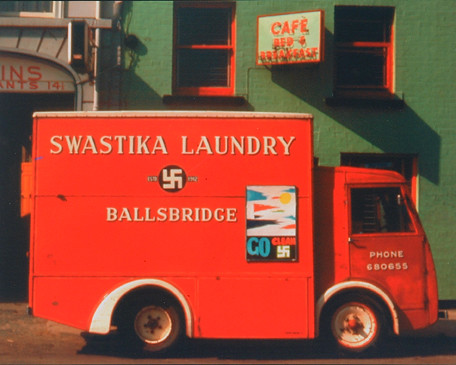
Is it legit?
LikeLike
I’d say that’s the real thing.
I’m wondering if my memory is playing tricks on me or did they paint the vans in a different colour in latter years…
LikeLike
What’s the big deal? The Free State had no part in the British war of aggression against Germans.
It’s nice to know the Germans had at least some symbolic support in Dublin.
LikeLike
My Mother and Father met each other while working at this laundry shop in Ballsbridge. They just use to call it the Swas. So if it werent for the Swastika I wouldnt have been here today. And I just discovered mine an old Adolf’s birthdays are only 2 days apart! My mother used to say the old jewish retirement homes would panic seeing the truck knock at the door for the linen!
LikeLike
Tell me Gareth, knowing what we know about the Third Reich do you think that last point you make is funny?
LikeLike
I had a Dutch friend at my school in Dublin in the 1960s, and his family took great offence at the Swastika. Nobody else seemed particularly bothered.
LikeLike
There is a Swastika on India House in Aldwych London, how about that then. I grew up in Dublin[1940 s] we never paid any heed to it ,it was a Laundry.
LikeLike
A reverse swastika, traditional symbol there. The Nazi’s used it the other way.
LikeLike
I have a theory- for what it is worth, here it is:
The Nazis used the reversed Swastika. In most instances up to their adopting it in the 1920’s, it was seen the other way around.
Hitler is said to have designed the Nazi Party symbol himself- complete with reversed swastika, red and white colour and all. He did it very quickly, with no preparatory work or sketches.
Now, there is a legend that the young Hitler visited Liverpool and Dublin before the first world war.
Is it possible that Adolf saw the swastika on the chimney, and filed away the memory for years, until he was called on to devise a symbol for the NSDAP?
Does the existence of the swastika as Nazi symbol prove that Hitler was in Dublin at some point?
LikeLike
Almost certainly not. The Swastika is an old Hindu symbol. The “Aryan race”, so-called, was reputed to have its ultimate origins in India: hence the Nazis’ adoption of the “hakenkreuz”.
LikeLike
ADOLF HITLER’S HALF-BROTHER Alois, was working as a waiter in the Shelbourne Hotel, Dublin, in 1909
http://www.dowlingfamily.info/i1910hit.htm
LikeLike
Alois, with whom Adolf had a good relationship, married a Dublin girl, too.
LikeLike
[…] friend of the CLR of the Swastika Laundry, well known to Dubliners across much of the 20th century. Here’s a post we did years back on them which gives some context [by the way, that post has got hit after […]
LikeLike
I remember as a kid thinking they were great fun ! ….Whatout lads ! ..Its awl Hitler !
LikeLike
I grew up in Dublin in the 50’s/60’s and remember the “Swastika” vans, electric vans were just beginning to become popular for commercial deliveries (bread & milk in particular). The truth is we really didn’t appreciate or understand the insensitivity of its awful association (logo) with the Nazi Socialist Party in W.W.2 Germany. It wasn’t until programs such as the “World at War” etc. were broadcast in the early 70’s that we (post war children) began to fully understand the horrific significance of the swastika. I’m not sure if this lack of knowledge in the post war years was as a result of censorship or just plain ignorance. Regarding the Swastika Laundry logo, when I finally did grasp its significance as a brand mark for Nazism I wondered why the company “Swastika Laundry” 1912 or whatever didn’t see fit to change the name & logo completely. Strange times indeed.
Jim
LikeLike
Ireland was very isolationist right up until the early 1970s. Joining the EEC (as was) in 1973 did begin to change the mindset of people – especially those outside Dublin.
For a young Dubliner growing up in the 1960s, watchuing BBC and ITV (as well as RTE) and reading lots of British boys comics – I felt I was pretty well up on what Nazi Germany had all been about and I certainly had reservations about these Swastika Laundy vans as theyu looked more “Nazi” than any vehicles the Nazis themselves actually used,.
LikeLike
Listen to Blindboy’s podcast on acast about the swastika laundry vans.
LikeLiked by 1 person